ads2

Monday, 17 February 2014

Parser View

With CLI view, we can restrict which access each network administrator have based on role.Superviews allow a network administrator to easily assign all users within configured CLI views to a superview instead of having to assign multiple CLI views to a group of users. 


Here is the basic configuration of the Parser View.


R2 <----> R3    
192.168.1.1   <---->  192.168.1.2


Task: 

  • Allowing telnet access with the username OPERATOR and password CISCO to be able to configure the HTTP feature in the router only.
  • Configure Username ADMIN and password CISCO to have access to every feature in the router.


aaa new-model
!
!
aaa authentication login default local
aaa authentication login VTY local
aaa authentication login CON none
aaa authorization exec default local
aaa authorization exec VTY local


username OPERATOR view HTTP password 0 CISCO
username ADMIN privilege 15 password 0 CISCO


parser view HTTP
 secret 5 $1$6ZRJ$CIjM5cdVUvhpinttlR/361
 commands configure include ip http
 commands configure include ip
 commands exec include configure terminal
 commands exec include configure
 commands exec include show running-config
 commands exec include show

Monday, 20 January 2014

Any Transport Over MPLS (AToM)

Any Transport over MPLS (AToM) will transport layer 2 frames over a MPLS (Multiprotocol Label Switching) network. This will allow service providers to connect layer 2 networks of customers transparently by using their MPLS backbone. AToM can transport the following:
  • ATM AAL5
  • ATM Cell Relay
  • Ethernet
  • Frame Relay
  • PPP
  • HDLC
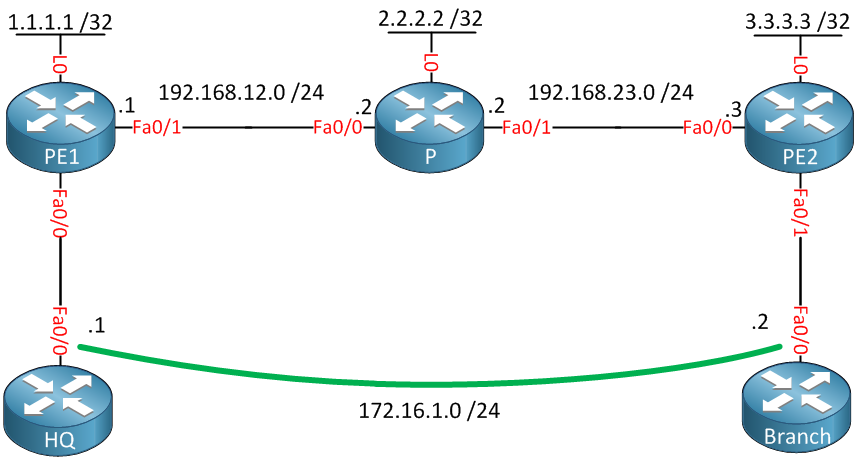
I will give you an example how to configure AToM to transport Ethernet over the MPLS backbone, we will use the following topology to do this:
MPLS Atom Ethernet
Above you see a small MPLS backbone that consists of the PE1, P and PE2 router. This ISP only has one customer that has a HQ and Branch. The customer wants to have the HQ and Branch router to be in the same layer 2 segment.

Cisco IOS NAT on a Stick Configuration Example

NAT (Network Address Translation) is most commonly used to let users on our LAN access the Internet using a single public IP address but it can be used for some more interesting scenarios. Recently I encountered an interesting CCIE R&S task that had the following requirement:
"Make sure that whenever R2 responds to a traceroute it replies with the IP address on the loopback 0 interface"
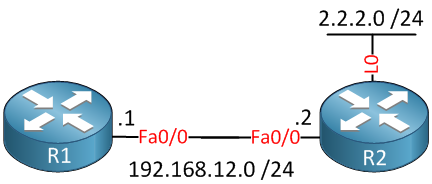
This sounds easy enough but there’s no such thing as a “traceroute source loopback 0″ command or anything alike. To make this work we have to configure the NAT on a stick feature. In this tutorial I’ll show you this is done. First of all, this is the topology that we will use:
Two Routers R2 Loopback Interface
There are only two routers that are directly connected to each other. R2 has a loopback 0 interface with IP address 2.2.2.0 /24. Let’s configure these IP addresses first:

Site-to-Site IPSEC VPN Between Two Cisco ASA – one with Dynamic IP

isco ASA 5500 Series appliances deliver IPsec and SSL VPN, firewall, and several other networking services on a single platform. Cisco ASA 5520, a member of the Cisco ASA 5500 Series, is shown in Figure 1 below.
asa5520 picture
Figure 1 Cisco Adaptive Security Appliance (ASA)

Thursday, 16 January 2014

Site-to-Site IPSEC VPN Between Cisco ASA and pfSense

IPSEC is a standardized protocol (IETF standard) which means that it is supported by many different vendors. Therefore if you want to create a VPN between different vendor devices, then IPSEC VPN is the way to go.
In this article we will see a site-to-site VPN using the IPSEC protocol between a Cisco ASA and a pfSense firewall. PfSense is an open source distribution of FreeBSD customized for use as a firewall and router. You can install pfSense on a PC with two (or more) NICs, essentially turning it into a flexible security appliance. You can obtain your copy of pfSense from the Downloads section of www.pfsense.org. At the time of this writing, the latest available release is 2.0.2 and the same has been used in this tutorial.
In this article, we will focus on site-to-site IPsec implementation between a Cisco ASA and a pfSense firewall, as shown in Figure 1 below.
Figure 1  Cisco ASA to pfSense IPsec Implementation (Click for Larger Picture)
IPsec - ASA to pfSense
We will start with a preconfiguration checklist that will serve as a reference for configuration of IPSEC on both devices. ISAKMP/Phase 1 attributes are used to authenticate and create a secure tunnel over which IPsec/Phase 2 parameters are negotiated.
Table 1   Preconfiguration Checklist: ISAKMP/Phase-1 Attributes

Wednesday, 15 January 2014

Another Java zero-day vulnerability being exploited in the wild

java
Do you still have Java installed? There is a bad news for you ! FireEye has detected yet another Java zero-day vulnerability being exploited in attacks in the wild.

The vulnerability targets browsers that have the latest version of the Java plugin installed Java v1.6 Update 41 and Java v1.7 Update 15 and FireEye warned that the vulnerability is being exploited to install a remote-access trojan dubbed McRat, researchers from security firm.

"Not like other popular Java vulnerabilities in which security manager can be disabled easily, this vulnerability leads to arbitrary memory read and write in JVM process,"

"After triggering the vulnerability, exploit is looking for the memory which holds JVM internal data structure like if security manager is enabled or not, and then overwrites the chunk of memory as zero."

The exploit is reportedly different from the one used to attack Facebook, Twitter, Apple, and several other companies last month.

It is not known if this particular Java vulnerability is on Windows only or on Linux and Mac OS X, too. However, McRat is a Windows Trojan so the in-the-wild attacks are specifically targeting Windows users.

If you don't want any chance of being infected, the best thing to do is uninstall Java altogether.

Old School Hackers spying on European governments

Old School Hackers spying on European governments
Kaspersky Lab's team of experts recently published a new research report that analyzed that Cyber criminals have targeted government officials in more than 20 countries, including Ireland and Romania with a new piece of malware called 'MiniDuke'.
In a recent attack, malware has infected government computers this week in an attempt to steal geopolitical intelligence. The computers were infected via a modified Adobe PDF email attachment, and the perpetrators were operating from servers based in Panama and Turkey.

According to Kaspersky Lab CEO Eugene Kaspersky,"I remember this style of malicious programming from the end of the 1990s and the beginning of the 2000s. I wonder if these types of malware writers, who have been in hibernation for more than a decade, have suddenly awoken and joined the sophisticated group of threat actors active in the cyber world."

208194132

Last week Adobe released an update that patches the Adobe PDF bug (CVE-2013-6040) used in the attack. Once it was opened, the MiniDuke malware would install itself on a victim's computer. It is not known what information the attackers are targeting.

MiniDuke attacks government entities in Belgium, Brazil, Bulgaria, Czech Republic, Georgia, Germany, Hungary, Ireland, Israel, Japan, Latvia, Lebanon, Lithuania, Montenegro, Portugal, Romania, Russian Federation, Slovenia, Spain, Turkey, Ukraine, United Kingdom and United States.

The malware also compromised the computers of a prominent research foundation in Hungary, two thinktanks, and an unnamed healthcare provider in the US.